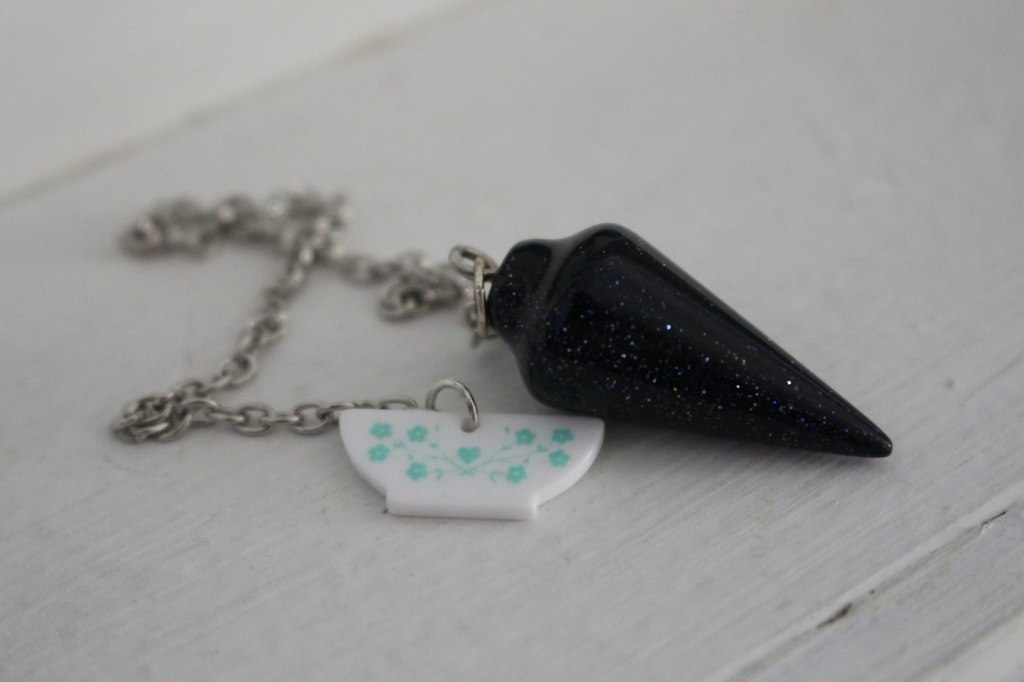
Learning how to use a pendulum is one of the quickest ways into divination, because all you need is a weight on a string and a quiet ten minutes. A pendulum is a small weight hung from a cord or chain that you hold still while you ask a question and watch which way it swings.
This guide covers what a pendulum is doing, how to choose one, how to set up your own yes and no, and a simple method you can try tonight. It also covers the limits, because a pendulum is a tool for reflection and not an oracle for big decisions.
Why pendulum divination works
Start with the mechanism. Britannica describes the ideomotor effect as a phenomenon in which a person makes involuntary physical movements in response to ideas, thoughts or expectations. It lists pendulum divination among the examples, where the answers result from tiny unconscious hand motions of the person holding the string.
That is the plain, tested explanation, and it is useful to know. Many practitioners treat the movement as a message from their own deeper attention, from intuition, or from spirit. Those are interpretations, and you can hold whichever fits your practice. What does not change is that your hand is the engine, so your state of mind shapes the result.
This is why the pendulum is good at surfacing what you already half know, and why it is poor at telling you things you could not know. It will not tell you next week’s lottery numbers. It can help you notice that you swing hard toward one option and flatten out at another.
Choosing a pendulum
Almost anything with a little weight works. Crystal points, metal, wood and glass are all common. A ring on a thread or a button on a string will do the job just as well while you are learning.
Pick a weight you can feel without it dragging your hand. Too light and it jitters with every breath. Too heavy and it tires your arm. A cord or chain of around 10 to 20 centimetres is easy to manage.
If you buy a crystal pendulum, check the stone first. Some stones are soft or react to water, which matters if you ever cleanse it. Our guide to cleansing crystals safely covers which stones suit which methods. Many people choose a pendulum because it feels right in the hand, and that is a sound reason.
Setting your yes and no
Pendulums have no universal code. One person’s clockwise circle is another person’s no. The reliable approach is to set your own and write it down.
Hold the pendulum steady between thumb and forefinger, with your elbow resting on a table so your arm is supported. Ask it to show you a yes, then watch the swing: it may circle, or move back and forth, or side to side. Ask for a no and note the difference. Ask for a maybe or a not-sure-yet as well, since that is often the most honest answer you will get. Repeat with a few obvious questions, such as whether it is currently night, until the pattern settles.
A simple method to try
Choose a quiet spot with a steady surface and no draught. Sit down, rest your elbow on the table, and hold the cord so the weight hangs a little above the surface. Take a few slow breaths until your hand feels still. Say your question aloud in a form that has a clear yes or no answer, such as whether you feel ready to start the course, rather than anything open-ended. Hold your attention on the weight, wait without pushing, and watch what it does. If it hovers without moving, take that as a pause: rephrase the question or leave it for another day. When you finish, thank the tool, note the question and the answer in your grimoire, and put the pendulum somewhere clean and dry. If you are not yet keeping one, our guide to starting a grimoire will help.
Making your questions work
Good questions are short, specific and about you. Ask whether a plan feels right, whether you have the energy for a task, or whether to begin a ritual now or wait. Poor questions are about other people’s private thoughts, about events you cannot influence, or about facts you could simply look up.
Because the ideomotor effect responds to expectation, a strong hope for one answer will often produce it. A useful trick is to notice your hope before asking, say it out loud, and then ask. You can also ask the same question twice, an hour apart, and see whether the answer holds. If it flips, the first answer was probably noise.
Seasonal timing in the southern hemisphere
Many practitioners like to consult a pendulum around the new moon, when they are setting intentions, or at the turn of a sabbat. In Australia it is late spring, so the days are long and you can often work in natural light, which is handy for watching the swing. There is no rule that a pendulum needs a particular moon or season, so treat this as a matter of taste.
Safety and sensible limits
- Do not use a pendulum to make medical, legal, financial or safety decisions. It reflects your own hand movements and cannot diagnose or advise. See a qualified professional for those questions.
- Do not wear or hang a pendulum around your neck while working, and keep the cord short enough that it cannot tangle around fingers or wrists.
- Keep small weights, beads and chains away from young children and pets, who can swallow or chew them.
- If you work by candlelight or with incense, keep the cord well clear of the flame, because thread and many cords burn easily.
- If a session leaves you anxious, stop and ground yourself with water and food. A tool for reflection should not become a source of dread, and you are always free to put it down.
- If you buy a stone pendulum, avoid water, salt and strong sunlight until you know what the stone is. Some minerals dissolve, crumble or fade.
Keeping it honest
The most useful habit is to record what you ask and what happens afterwards. Over a few months you will see whether your pendulum is a useful mirror for you, and where it simply echoes your hopes. Treat it as a way to listen to yourself with more care, and it will earn its place on your altar.
Photo by Haley Owens on Unsplash.


Leave a Reply