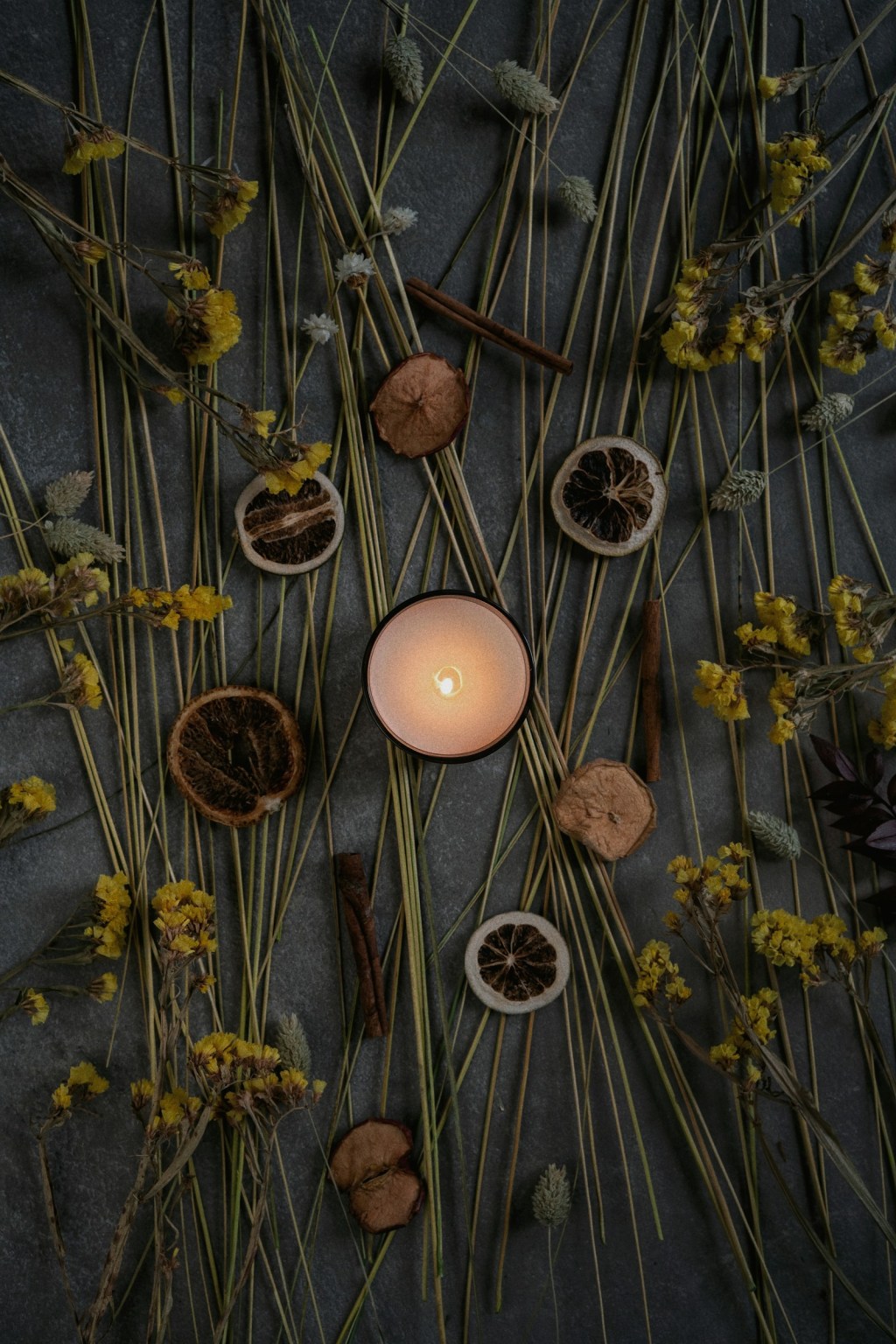
Knowing how to dress a candle is one of the most useful basics in practical magic, because it turns a plain household object into a focused working tool in about two minutes. Dressing means coating the candle with oil, and sometimes pressing fine herbs onto it, while you hold your intention. This guide covers why the practice works, what to use, a safe method, and how to avoid the fire risks that come with adding anything flammable to something that is already burning.
Why dressing a candle works
A candle on its own is a light source. A dressed candle is a decision you have made with your hands. The act of choosing an oil, handling the wax, and running your fingers along it while you name what you want gives your attention somewhere to land. That is the practical mechanism: the ritual narrows a vague wish into a physical sequence, and the flame then acts as the long, slow finish to it.
Candles have been part of devotional and folk practice for a very long time, and the habit of anointing objects with oil to mark them as set apart is older again. Modern witchcraft and folk magic traditions borrow from both. The details of who does what vary a lot between traditions, so treat any rule you read, including the ones here, as a convention you can test rather than a law.
Choosing your materials
Think of each material as an ally with its own character. Rosemary is sharp, clearing and protective. Lavender is soft and settling. Bay laurel is dry and decisive, good for release and for goals. A carrier oil such as olive or sweet almond is the body that carries them. If you have not made your own yet, our guide to making anointing oil from a dried herb infusion gives you a safe base to work from.
You will need a candle, a small dish of oil, a clean cloth, and optionally a pinch of very finely crushed dried herb. Choose a candle you can actually burn safely. A chime candle or a small pillar in a deep, stable holder is easier to manage than a tall taper. If you are buying supplies, Mountain Rose Herbs and Lucky Mojo both sell herbs, oils and candles, though Australian biosecurity rules and shipping costs apply to US orders, and you should check the requirements at the Department of Agriculture before you order dried plant material. Many Australian herb shops and supermarkets stock rosemary, lavender and bay locally, which avoids the problem entirely.
Choosing the colour and the intention
Colour correspondences are a convention, not a physical effect, and different traditions disagree. A common starting set is white for general clearing and new beginnings, green for growth and money, red for courage and drive, blue for calm and communication, and black for banishing and protection. Pick the colour that means something to you, because your association is what does the work. Then write your intention as one short sentence in the present tense, such as “I speak clearly and I am heard”.
How to dress a candle: the method
Wash and dry your hands, set the candle on a clean cloth, and have your oil dish within reach. Take a few slow breaths and say your intention aloud once. Put a small amount of oil on your fingertips, a few drops is plenty, and begin at the middle of the candle. A widely used convention is to stroke from the middle up to the top and then from the middle down to the base when you are calling something towards you, and to stroke from the ends towards the middle when you want to send something away or reduce it. Some practitioners reverse this, and it makes no practical difference as long as you decide in advance and stay consistent. Keep the strokes slow and even while you repeat your sentence in your head, and keep the oil thin, so the surface looks lightly glossed and nothing drips. If you want to add herb, lay a small pinch of crushed leaf on the cloth and roll the oiled sides of the candle through it so only a light dusting sticks, keeping the top, the wick and the first few centimetres around it completely clear. Wipe your fingers, set the candle in its holder on a heat-proof surface, say your intention once more, and light it with a match or lighter while you watch the flame settle. Let it burn while you are in the room, then snuff it when you leave rather than leaving it to finish unattended. If the candle is a small one that will finish in an hour or two, you can sit with it. If it is a larger one, burn it in short sessions across several days and treat each relighting as a return to the same working.
Safety: do not skip this
Adding oil and herbs to a candle changes how it burns, so the fire risk is higher than with a plain candle. Dried herbs are fuel. Large pieces, loose flakes and thick coatings can flare, spit or smoulder, so use only a very fine dusting kept well away from the wick, or skip the herb entirely and dress with oil alone. Keep the oil layer thin so it cannot run down into the holder or pool near the flame.
Fire and Rescue NSW advises that you never leave candles unattended, keep them on a secure base, and put them out when you leave the room or go to bed. Keep them away from curtains, upholstery and anything else that can catch. Use a heat-proof holder or plate, and keep matches and lighters out of reach of children.
- Never put neat essential oil on your skin or on a candle you will handle. If you use essential oil at all, dilute it in a carrier oil first, patch test on your inner arm, and wash your hands afterwards.
- Essential oils and some herbs can be harmful to cats, dogs and birds, so keep your oil, herbs and burning candle out of reach and in a well-ventilated room if you share your home with animals.
- Do not use plants you cannot identify with certainty, and do not use toxic plants in anything you burn or handle.
- Wipe up oil spills straight away, since oiled surfaces are slippery and the oil is combustible.
- Do not move a lit candle, and let glass holders cool before touching them.
- If you are pregnant, have asthma or sensitive skin, or react to fragrance, keep to unscented plain oil or no herbs at all. This is general caution and not medical advice.
Timing and aftercare
Many practitioners match the candle to the moon, burning drawing work as the moon grows toward full and release work as it wanes. If you want to try that, our guide to the moon phases in witchcraft sets out the southern hemisphere view. With the Scorpio new moon due on 9 November, the stretch ahead suits slow, private work, such as dressing a candle to support a decision you have been circling.
When the candle has burned out or you have finished with it, let it cool fully. Small leftover wax and any ash can go in the household bin once it is cold, and a clean glass jar can be washed and reused. Write a line in your notebook about what you used and what you noticed, since a record of what you tried is how you find out what works for you. A plain beeswax or soy candle and a small bottle of herb-infused oil are enough to start, and that sort of simple tool is covered at The Spiritual Toolbox if you want a reference for ritual basics.
What dressing a candle will and will not do
Dressing a candle will focus your attention, give your intention a physical form, and mark a stretch of time as deliberate. It will not replace the practical steps toward whatever you are working on. Pair the candle with an action you can take this week, and you have a working that rests on something real.


Leave a Reply