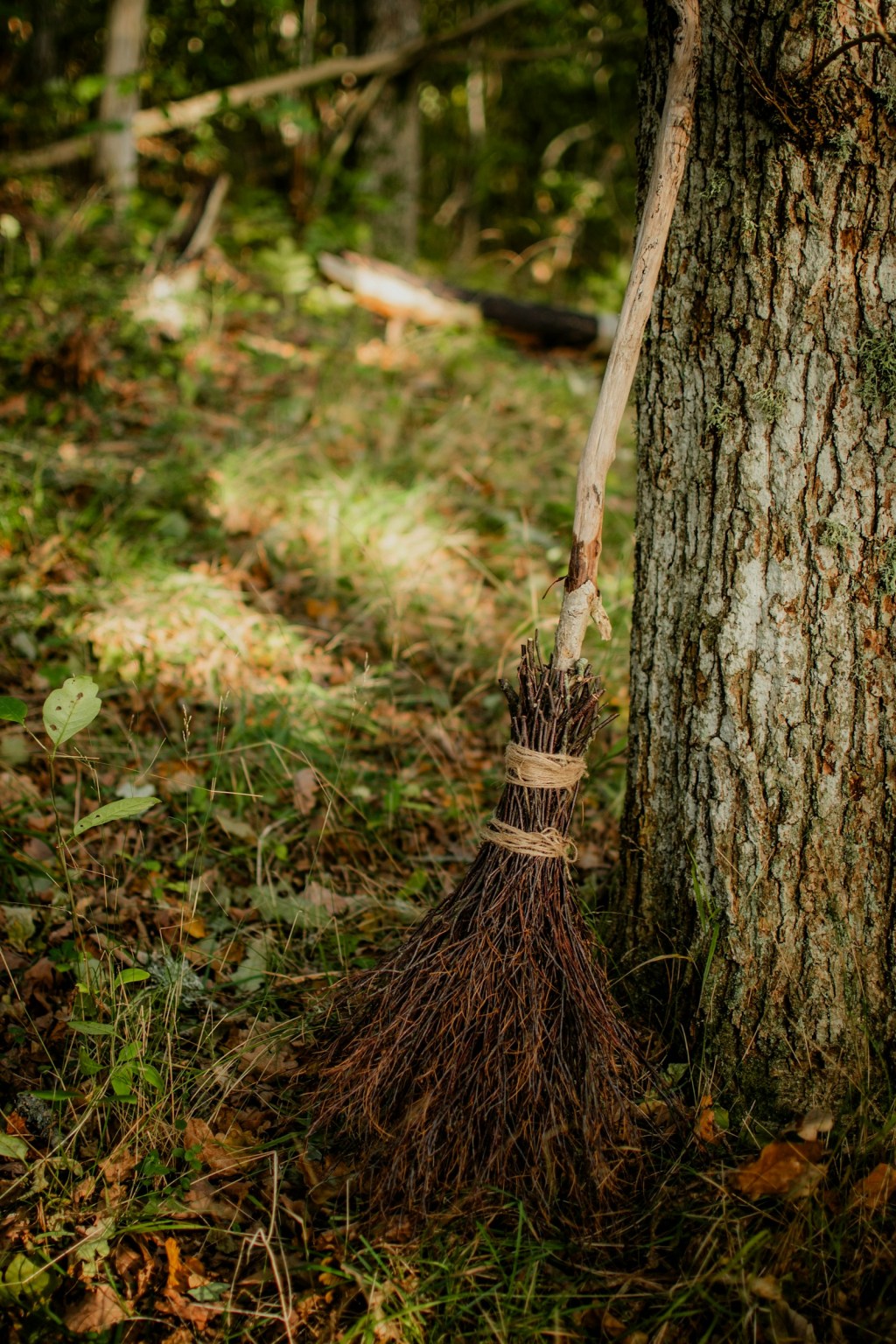
Learning how to make a besom is one of the most satisfying jobs in practical witchcraft, because you end up with a tool you can use every week. A besom is a traditional broom: a bundle of twigs bound around a stout pole, which gives the head a rounded shape rather than the flat one of a shop-bought broom. This guide covers where the besom comes from, why it works as a magical tool, and a method for building one from materials you can gather in Australia.
What a besom actually is (and what the history says)
The word is reserved for the old style of broom. According to Wikipedia’s entry on the besom, the traditional head is birch twigs, the handle is hazel, and the binding is split withy, while modern versions often use wire and string. Heather and broom (Genista) twigs are also used for the head.
The flying witch is a later image. The earliest known reference to a flying broomstick that Icy Sedgwick’s folklore article on the broomstick points to is a 1453 confession by Guillaume Edelin, and the article itself treats it with caution because it was given under torture. Some researchers have speculated that the image grew from women using staves to apply “flying ointments” made from plants such as deadly nightshade and henbane. That is a theory, not settled history, and those plants are poisonous. Nothing in this post involves them.
What is well recorded is the household folklore. Brooms were laid across doorways to keep out harm, a broom and spade were crossed as a guard against lightning, and people avoided sweeping after sunset or took an old broom with them when moving house, according to the same article.
Why a besom works as a magical tool
Most of the effect comes from how humans attach meaning to repeated, deliberate acts. A broom already has one job, which is to move unwanted material out of a space. When you make your own and give it a single ritual purpose, every use becomes a small act of intention. You are training attention, and that is a legitimate mechanism for any craft.
The materials add their own character. Practitioners who work relationally tend to treat each plant as an ally with a temperament. Tea-tree and eucalyptus are fierce and clearing. Lavender is soft and settling. Rosemary is watchful and has a long association with remembrance and protection, as in the salt and rosemary threshold working. Choosing a mix is part of the spell. None of this changes the physics of dust. It changes how you stand in your own home when you sweep.
Materials for an Australian besom
The old European recipe leans on birch and hazel, which many Australians cannot easily source. Use what grows near you and that you can take legally.
For the head, you need roughly a handful of thin, dry, flexible twigs around 50 to 60 centimetres long. Good options are prunings from your own garden, windfall twigs from a friend’s property (with permission), or off-cuts from a tea-tree or lavender hedge. Woody rosemary and lavender stems are fragrant but brittle, so mix them with a sturdier twig as the structural core.
For the handle, use an untreated hardwood dowel or a straight, fallen branch about 2.5 to 3 centimetres thick and 100 to 120 centimetres long. For binding, use jute twine, waxed cotton cord or soft garden wire. Add secateurs, a sharp pair of scissors, gloves and a dust mask.
If you want to buy dried herbs or twine rather than gather them, US suppliers such as Mountain Rose Herbs and Sage Goddess are popular, but note that Australian biosecurity rules and shipping apply to US orders, so check the Department of Agriculture before you buy plant material.
How to make a besom: the method
Start by gathering and drying. Cut your twigs and lay them somewhere airy and out of direct sun for two to three weeks, until they have lost their green sap but still bend a little before they snap. Spring prunings are ideal in the southern hemisphere, as shrubs have just finished flowering and are putting out new growth. Take only what a plant can spare, and thank it if that is your practice. Bundle and bind while the twigs are slightly flexible, because fully brittle twigs shed badly.
Sort the twigs by length and trim the butt ends level with the secateurs. Gather them into a bundle thick enough that your hand just closes around it, keeping the sturdy twigs on the outside and the fragrant, softer ones in the centre where they are protected. Tie the bundle tightly with a first band of twine about 15 centimetres from the cut ends, wrapping at least a dozen times and finishing with a firm knot. Slide the handle into the centre of the bundle until it sits a few centimetres past that first band, then add a second and third band further up, pulling each one as tight as you can. Wire holds better than twine if the twigs are very slippery. When the head no longer twists on the handle, trim the bristle tips level, shake it out and leave it overnight to settle.
To dedicate the besom, hold it at a doorway or hearth, say aloud what its single job will be, and sweep the floor of one room toward the door with it for the first time. Pick one purpose, such as clearing a room after a difficult conversation or sweeping the threshold on the first of each month. A besom with one job is more convincing to you than a besom with five. If you want to tie it to the season, the Beltane working for 31 October is a natural time to bring a new tool into use.
Safety and sensible limits
Wear gloves and a dust mask when trimming dried material, as dried plant dust can irritate skin, eyes and airways, and fresh splinters get under the skin easily. Do not use chemically treated timber for the handle, since treated pine can contain preservatives you do not want in a tool you handle daily. Keep eucalyptus, tea-tree and other aromatic twigs away from pets that chew, and never burn the besom indoors or leave it near candles, because dry twigs ignite fast.
Do not collect plant material from national parks, nature reserves or other protected areas. Rules generally prohibit taking wood or plants from national parks, and fines can apply, so check your state or territory’s park rules. Avoid threatened native plants entirely. Some states also restrict moving plant material across their borders, so check the local quarantine rules before you carry twigs interstate. Skip anything poisonous, including the nightshade family and oleander, however much folklore mentions them.
Finally, keep your expectations honest. A besom is a focus for intention and a decent tool for sweeping a verandah. It will not replace repairs, boundaries or a conversation you have been avoiding. It can help you commit to doing them. If you also enjoy making protective tools, the guide to making a witch bottle pairs well with a freshly made besom at the front door.


Leave a Reply