Jupiter retrograde in Leo begins on Sunday 13 December 2026 in Australian Eastern Daylight Time, and Neptune turns direct on the same morning. Two big planets changing gear on one day makes a natural pause point, so this post covers the timing, the astronomy behind the word retrograde, how practitioners read the transit, and a simple sunflower and candle working you can do at home.
Jupiter retrograde in Leo: the timing in AEDT
Cafe Astrology lists Jupiter stationing retrograde at 27 degrees 01 minutes of Leo on the evening of 12 December in US Eastern time. Converted, that is around 11.56 am AEDT on Sunday 13 December. The Cafe Astrology Neptune page gives Neptune’s direct station at 1 degree 37 minutes of Aries, also on 12 December US time, which works out to roughly 9.17 am AEDT on 13 December.
Sources round stations differently and some only give a date, so you will see both 12 and 13 December around the web depending on the time zone a site uses. Treat the clock times here as approximate and the date as your anchor.
What retrograde means in astronomy
Retrograde is an apparent motion. Britannica describes it as the apparent, brief reversal of a planet’s motion as seen from Earth, an effect that depends on the difference in orbital speeds between the planets. Jupiter takes about 12 years to circle the Sun, while Earth takes one, so Earth catches up with Jupiter and overtakes it roughly every 13 months.
Around that overtaking, Jupiter seems to slow, stop, drift backwards against the background stars for about four months, then stop again and resume its forward path. Those two stops are the stations. On 13 December Jupiter halts its forward drift and begins the backwards stretch. The middle of the loop is opposition, when Earth sits between Jupiter and the Sun. Royal Museums Greenwich lists Jupiter’s next opposition on 11 February 2027, so by then the planet will be rising around sunset and shining all night in Leo.
Jupiter turns direct again in mid-April 2027 at 17 degrees of Leo. It crossed 17 degrees of Leo on 16 September 2026, which is when the retrograde shadow began, and it will not fully clear that shadow until it passes 27 degrees of Leo again on 10 July 2027. Jupiter has been in Leo since 30 June 2026 and moves on in late July 2027.
Jupiter in Leo: the astrological reading
From here the post moves from astronomy to astrology, which is interpretation and tradition rather than measurement.
Jupiter is traditionally the planet of expansion, generosity, teachers, meaning and the long view. Leo is a fixed fire sign tied to the heart, creative play, visibility and pride. Since June, Jupiter in Leo has favoured people who put themselves forward: bigger projects, bigger audiences, bigger gestures. A retrograde turns that outward push around for review.
A common practitioner reading is that this retrograde asks which of your expansions came from the work itself and which came from wanting to be seen, and what is still worth doing once the applause is taken away. It suits refining, editing, practising and finishing. It is a harder stretch for launching something untested, so many people use it to tighten what already exists.
Down here the timing is tidy. The station lands in early summer, about a week before the solstice, when daylight is at its longest and fire imagery is literal. Leo’s sun-gold palette matches the season, which is why the working below uses a yellow flower and a flame, with fire safety taken seriously.
Neptune direct on the same day
Neptune has been retrograde in Aries since 7 July 2026. Practitioners read Neptune as the planet of imagination, dreams, idealism and fog. While it is retrograde those themes turn inward, and when it goes direct they head back out into the world. Saturn turns direct in Aries two days earlier, which I covered in the Saturn direct post, so both outer planets in Aries resume forward motion within the same week.
Read together, Neptune direct offers a clearer picture of what you are actually dreaming towards, while Jupiter retrograde asks whether it deserves the size you have given it. Neptune also blurs edges, so a practical habit for this week is to write things down. The working below is built around exactly that.
A sunflower and candle working for Jupiter retrograde
A review works best when it has a boundary and a record. A candle supplies the boundary, because it burns for a set time and everything you want to say has to fit inside it. A written two-column list supplies the record, which you can reopen in April when Jupiter turns direct.
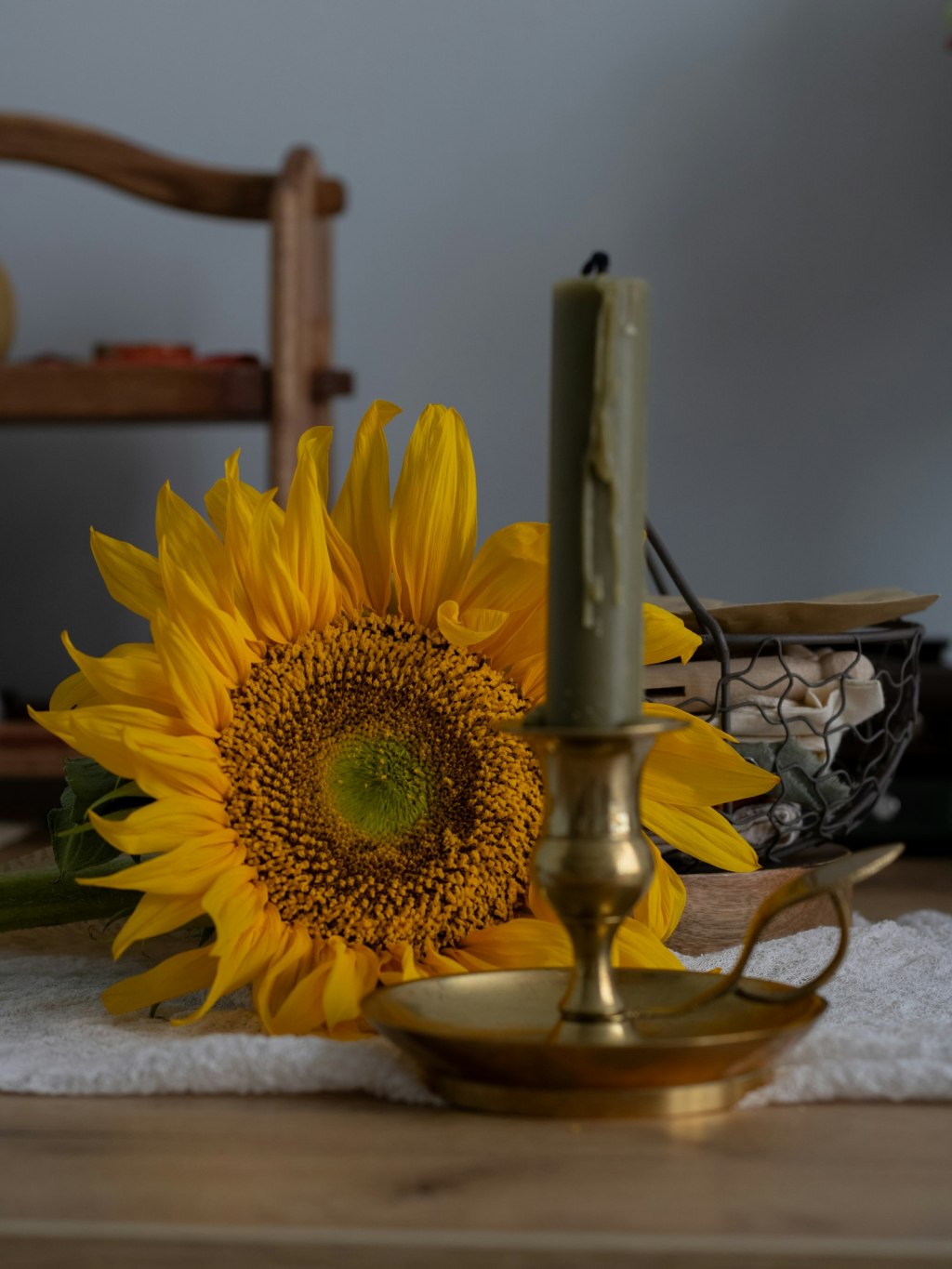
The sunflower is the ally for this one. It is a tall, open-faced, heavy-headed plant, young sunflowers turn to follow the light, and a mature head gives its seed away generously. Those traits sit comfortably with Jupiter in Leo, where generosity and visibility meet. Treat the flower as a guest with its own character: ask for its company rather than commanding it.
You will need:
- a yellow or gold candle (a tealight in a holder is ideal)
- one fresh sunflower, or another yellow flower from the garden
- a sheet of paper and a pen
- a heatproof saucer or tile to stand the candle on
Choose a time on Sunday 13 December after the stations have passed, late afternoon or dusk suiting a candle best. Clear a small, flat, uncluttered space, put the saucer down and stand the sunflower in a vase or jar nearby, then rule a line down the middle of your paper. On the left, write what you have grown or enlarged since Jupiter entered Leo on 30 June: projects, audiences, spending, commitments, favours, anything you have made bigger. On the right, write which of those were done for the work or the people involved and which were done for applause, and be blunt with yourself because nobody else will read it. Light the candle and say aloud, “Jupiter turns to look back, and so do I.” Read both columns slowly, then circle one item you want to keep expanding and underline one you want to pare back or finish quietly. Hold your hands near the sunflower, thank it for keeping you company, and ask it what it would like you to notice. Sit with the candle for as long as feels useful, then snuff it out with a snuffer or a damp fingertip and fold the paper in half. Tuck the paper into your grimoire or a drawer and write a date on the outside for mid-April 2027, when Jupiter turns direct, so you can reopen it and see which circled items turned out to be true.
Safety notes
Keep the flame on a heatproof surface well away from curtains, paper, dry flowers and anything else that burns, and do not leave it unattended, even a tealight. Do not burn the paper. Keep candles out of reach of children and pets. Summer is fire season here, so never light a flame outdoors on a Total Fire Ban day and check your state rural fire service for local rules before using any flame outside.
The ASPCA lists sunflowers as non-toxic to cats and dogs, though chewing any plant can upset a stomach. If you swap in a different yellow flower, check it first, because lilies appear on the ASPCA list of plants dangerous to cats. Wash your hands after handling stems, and do not eat any part of a flower you have used in a working.
What to watch until April
The retrograde runs through the summer and the first half of autumn, so there is time to let the review settle. Jupiter’s opposition on 11 February 2027 is the natural midpoint to check in, and the direct station in mid-April closes the loop. For the rest of December, including the lunations and the solstice, see the December 2026 astrology guide.


Leave a Reply