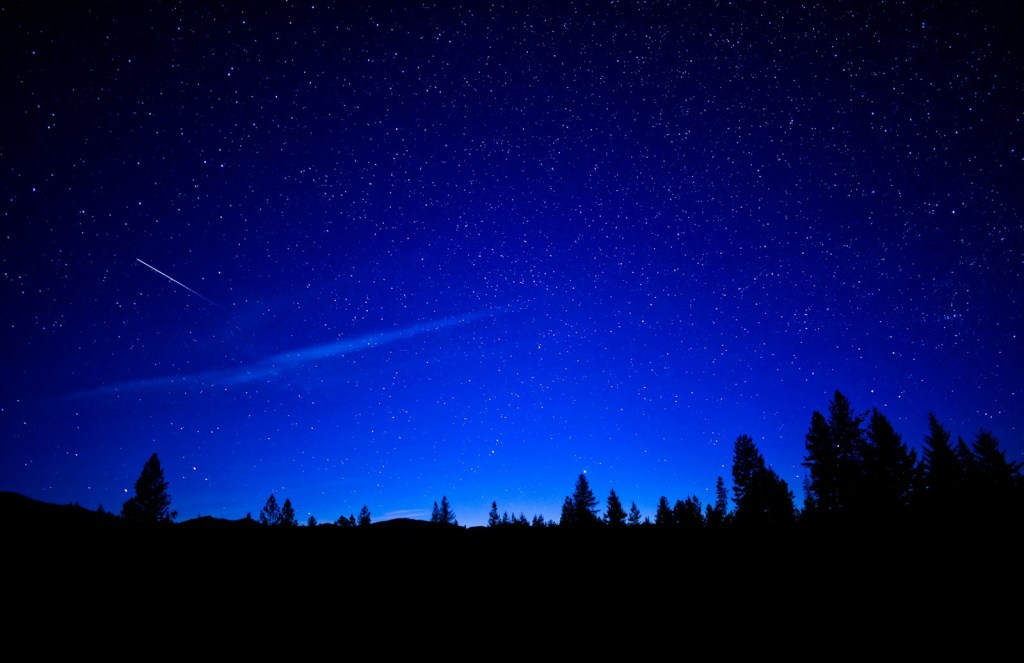
The Taurid meteor shower 2026 is already under way, and it builds towards two predicted peaks in early November that fall either side of a dark new moon. All times here are AEDT (UTC+11), so check your own state’s offset if you are outside the east coast.
This is a quiet shower, not a spectacle. If you go in expecting a curtain of lights you will be disappointed. If you go in expecting a few slow, bright streaks and a long stretch of dark sky, it is a lovely way to mark the turn of a season.
Taurid meteor shower 2026: the dates in AEDT
The Taurids are really two overlapping streams. The Southern Taurids are active from about 10 September to 20 November, and the Northern Taurids from about 20 October to 10 December, according to the Royal Observatory Greenwich. Neither stream has a sharp peak, and sources differ on the exact timing.
EarthSky, using American Meteor Society predictions, gives the Southern Taurid peak as 19:00 UTC on 5 November and the Northern Taurid peak as 18:00 UTC on 12 November. Converted to AEDT, that is around 6am on 6 November and around 5am on 13 November. Treat those as the centre of a broad window, because meteor shower peak times can shift. Star Walk lists the same two November maxima as 4 to 5 November and 11 to 12 November.
The new moon falls at 6.02pm AEDT on 9 November, so the moon is a thin crescent or absent for the whole stretch. That is the real gift of 2026: dark skies at both peaks. We cover that new moon in our Scorpio new moon guide.
What to expect from the sky
Both streams produce about five meteors an hour under good conditions, and roughly ten in total when they overlap. Those are ideal rates with the radiant high overhead, so your count will usually be lower.
What the Taurids offer is character. They are slow meteors, and the Southern stream is known for the occasional fireball. EarthSky, quoting the American Meteor Society, notes that in most years only about 1 per cent of Taurids are fireballs. That is why they are nicknamed the Halloween fireballs in the northern hemisphere. A bigger swarm of fireballs is predicted for 2032, not this year.
The debris behind the Southern Taurids comes from Comet 2P/Encke. The Northern stream is linked to an asteroid called 2004 TG10, which Star Walk describes as an offshoot of Encke. NASA’s overview of meteors and meteorites explains how this kind of comet dust becomes a streak of light as it hits the atmosphere.
Watching from Australia
The Taurids can be seen from both hemispheres. The radiant sits in the constellation Taurus, near Aldebaran, and EarthSky says it rises in the early evening and is highest around midnight. From Australia, Taurus sits in the northern part of the sky, so face roughly north and let your eyes take in as much sky as you can rather than staring at one spot.
Give your eyes at least twenty minutes without screens. Get away from streetlights if you can, lie back on a mat or reclining chair, and plan on an hour or more. The hours around midnight and the pre-dawn hours are your best bet. Spring nights can turn cool, so bring a blanket and a thermos.
The astrology, kept separate
Everything above is astronomy. The astrology is a separate layer of meaning that practitioners add. The radiant is in the constellation Taurus, but the Sun is currently in Scorpio, so the shower sits opposite the Sun in the sky. Many practitioners read Taurus as the sign of the body, the land and what we value, and Scorpio as the sign of release and endings. A meteor shower that falls across a Scorpio new moon, with Mercury retrograde, is an easy image for letting go of something slowly. That is an interpretation, not a fact about the shower.
A simple night sky ritual
Meteors work well as a ritual focus because they are brief and cannot be held onto. That makes them a good fit for the work of releasing something, since the act of watching trains you to let a thing pass. Choose one small thing you are ready to put down, such as a habit, a grudge or a story you keep retelling, and write it on a slip of paper before you go outside. Settle into your spot with the paper in your pocket, spend the first ten minutes simply letting your eyes adjust and breathing slowly, and then hold the thing you are releasing in mind while you watch. Each time a meteor crosses the sky, quietly name the thing and let the streak carry your attention away from it, and when you have seen three or four, or the cold has had enough of you, say thank you to the night sky out loud and head inside. In the morning, tear the paper into small pieces and put it in the recycling or compost, then note in your grimoire what you released and what you saw. If you do not have a grimoire yet, our guide to starting a grimoire is a good place to begin.
Safety
This ritual uses no flame, so there is little fire risk, but night watching has its own hazards. Tell someone where you are going, and do not drive tired to a dark site. Watch for snakes and other wildlife in the bush at this time of year, wear closed shoes, and use a red torch rather than a white one so you keep your night vision. Take warm layers, because spring nights can drop quickly, and stay off roads and out of private land. If you bring a candle or fire, check fire restrictions for your area first, since spring grass can be dry. Meteors are small particles burning up high in the atmosphere and pose no risk to people on the ground.
Looking ahead
The Taurid window closes in December, which is also when Saturn and Neptune turn direct. Our December 2026 astrology guide covers what is coming.


Leave a Reply