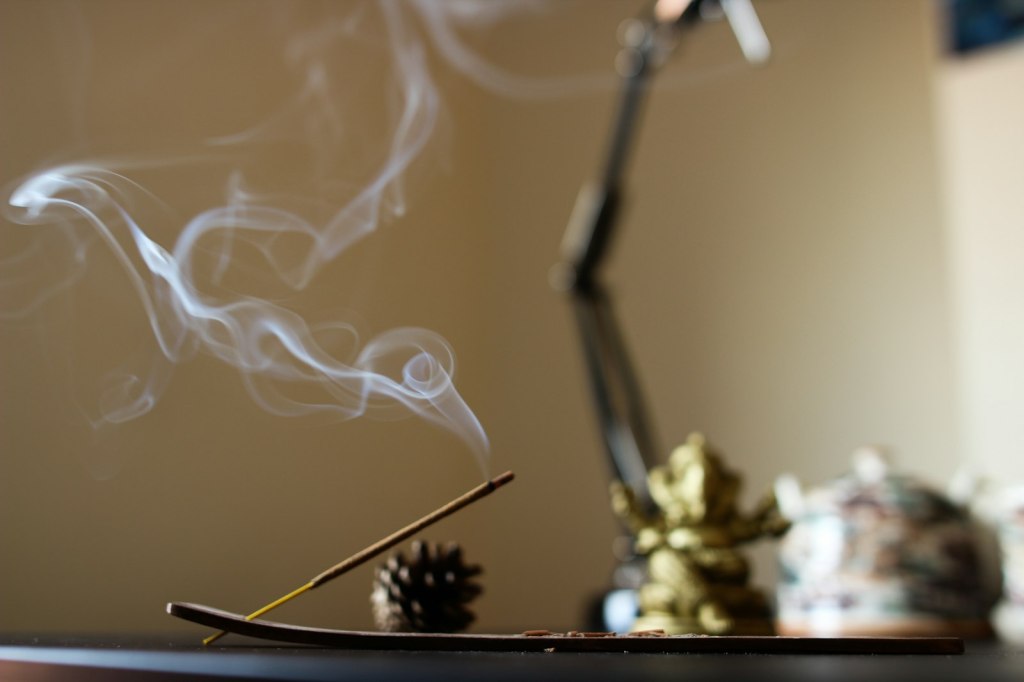
Learning how to make incense is one of the most satisfying small projects in practical witchcraft, because you end up with a working tool that smells like the intention you built it around. Loose incense is simply dried herbs, resins and sometimes citrus peel, ground and blended, then burned in small pinches on a heat source. It costs very little, it can be made in an afternoon, and it needs more care than most crafts, which is why the safety section below matters as much as the recipe.
A short history of burning resins
Burning fragrant material as an offering is very old and very widespread. Britannica’s entry on incense notes that incense-bearing trees were imported into ancient Egypt from the Arabian and Somali coasts, that incense featured in daily temple ritual and in funeral rites, and that the Babylonians used it while praying and divining. It records Greek use of woods and resins as offerings from the 8th century BC, imported incense in Roman public and private sacrifice, and later use in Christian ceremony, Hindu and Buddhist offerings, Chinese ancestor rites and Shinto ritual. Britannica names frankincense and myrrh among the chief historical incense substances, usually sprinkled on lit charcoal in a censer.
So when you blend your own, you are working inside a very long human habit. That does not make a particular recipe ancient. Modern witchcraft blends are modern, built from traditional ingredients, and it is fair to say so.
Why incense works as a ritual tool
Smell is tied closely to memory and mood, and it is the sense most people forget to use deliberately. If you burn the same blend every time you sit down to a particular kind of work, your body learns the association. After a few repetitions, the scent alone shifts you into the right frame of mind. That is a practical, observable mechanism, and it is a big part of why a personal blend beats a random shop-bought stick.
Smoke also gives you something to watch. A slow curl rising from the bowl is a natural focus point for the minutes you spend setting an intention, which is useful if your mind tends to race.
Beyond that, many practitioners treat each plant as an ally with its own character. Rosemary is brisk and clearing, lavender is soft and settling, frankincense is slow and sober, and a little dried orange peel brings brightness. Blending is then a conversation between those characters. You are asking what each one brings and how they sit together.
Choosing your ingredients
A simple loose blend has three parts: a base resin, a leaf or flower body, and a bright note. For a general clearing and focus blend, use these proportions by volume:
- 2 parts frankincense tears, crushed small (the resin base and the slow burner)
- 2 parts dried rosemary leaves (clearing, steady)
- 1 part dried lavender buds (softening, calming)
- 1 part dried citrus peel, orange or mandarin, thoroughly dry and finely chopped (brightness)
- Optional: a very small amount of crumbled dried bay leaf
It is spring here, so rosemary and lavender are in good supply in many Australian gardens. Dry your own by hanging small bunches in a shaded, airy spot for one to two weeks until they snap, then strip the leaves. Herbs that still hold moisture smoulder badly and produce harsh, wet-smelling smoke, and they can go mouldy in storage.
Resins and dried herbs can be bought from suppliers such as Mountain Rose Herbs or Sage Goddess in the US. Both are US suppliers, so Australian biosecurity rules and shipping costs apply to anything posted here, and plant material can be restricted. Check the Australian Government Department of Agriculture website before you order. Many local herb shops and apothecaries stock frankincense and dried lavender, which avoids the problem.
How to make incense: the blending
Make sure every ingredient is completely dry. Frankincense tears are hard, so freeze them for ten minutes and crush them in a mortar with a heavy pestle, wearing glasses or keeping the bowl low so shards do not fly. You want pieces about the size of a lentil, not a fine powder, because powdered resin melts into a sticky puddle and burns fast. Crumble the rosemary and lavender between your fingers, chop the citrus peel small, and combine everything in a clean bowl.
When you blend, take your time and treat it as the working itself. Sit with the bowl in front of you and say aloud, in your own words, what this blend is for, for example clear thinking while Mercury is retrograde. Add each ingredient in turn, name it, and say what you are asking of it before stirring it in with a wooden spoon or your clean fingers. Stir slowly clockwise (deosil) for the northern tradition, or in whichever direction your own practice uses, until the mix looks even. Hold your hands over the bowl for a minute and breathe slowly, then spoon the blend into a small glass jar with a tight lid, label it with the ingredients and today’s date, and leave it somewhere dark and cool for a week so the scents settle together. Add a note to your grimoire about what you used so you can adjust the next batch.
How to burn loose incense
Loose incense needs a heat source underneath it. The traditional one is a charcoal disc made for burning incense, which you light on its edge with tongs, set on a bed of clean sand or ash in a heatproof dish, and wait until it is grey on top before adding a small pinch of blend. Use a pinch, not a spoonful. Resin and herbs burn quickly, and a small amount gives you ten or fifteen minutes of scent.
If you would rather avoid charcoal, an electric incense or resin warmer heats the blend without combustion. It gives a gentler, less smoky scent, and for many homes it is the better choice.
Self-igniting charcoal discs spark when lit and then burn very hot for a good while, so only ever set them in a proper heatproof censer or a deep ceramic or metal dish half-filled with sand, on a stable surface, away from curtains, paper and anything that can tip over. Never hold the disc in your fingers while it lights.
Safety
This is the part to read twice. Incense involves fire, hot surfaces, smoke and plant material, so take these steps every time.
- Carbon monoxide. Burning charcoal produces carbon monoxide, which NSW Health describes as colourless, odourless and tasteless, and it advises that charcoal and similar fuels be used in well-ventilated outdoor spaces only (NSW Health). A letter in the Medical Journal of Australia reported dozens of accidental poisonings from charcoal burned in enclosed spaces. Those cases involved barbecue charcoal burned for heating, not a small incense disc, but the principle is the same: do not burn charcoal in a closed room. Burn incense charcoal outdoors, on a verandah, or in a room with windows and doors open, never in a bedroom, never while you sleep, and never in a tent or caravan. If you want to burn indoors regularly, use an electric warmer instead.
- Fire. Never leave burning charcoal unattended, keep a bowl of water or a lid nearby, and let the disc burn out completely and go cold before you throw it away. During bushfire season, check your state fire authority for total fire bans and do not burn open flame or charcoal outdoors on a ban day.
- Smoke. Smoke from burning any plant material can irritate eyes and airways. If anyone in the household finds the smoke bothersome, stop burning and ventilate the room. Birds in particular have sensitive airways, so keep pet birds well away, and keep cats and dogs out of the room as well.
- Skin and children. Keep the censer and charcoal well out of reach of children and pets. Hot dishes stay hot long after the smoke stops, so let everything cool before handling it.
- Ingredients. Only burn herbs you can identify with certainty. Do not use any plant you are unsure about, treated flowers from a florist, or plants sprayed with pesticide. Do not make or burn blends using anything poisonous, and never use essential oils or perfumes on the blend as fillers, since they can flare.
- No health claims. Incense is a ritual and sensory tool. It does not treat any condition.
Using your blend through the season
Because this blend is steady and clear, it suits quiet working evenings and the first weeks of Mercury retrograde, which begins on 24 October AEDT. You can pair it with the three-knot cord working we covered earlier, burning a pinch outdoors on the verandah before you tie the knots. For the warm months ahead, try swapping the citrus peel for dried mint or a little extra lavender, and keep each batch small so it stays fresh. A blend left in a clear jar on a sunny shelf loses its scent quickly, so store it dark.
Keep notes on every batch. What you burned, how long it lasted, and how it felt in the room is the information that turns a recipe into your own blend.


Leave a Reply